Innovations from Leading 3D Visionaries
- Paul Ian Masendo
- 2 minutes ago
- 4 min read

The world of 3D visualization is evolving fast. Every day, new tools and techniques push the boundaries of what we can create and see. For architects, interior designers, product manufacturers, and real estate developers, these advances are more than just cool tech. They shape how ideas come to life, how projects get approved, and how clients connect with designs before a single brick is laid.
In this post, I want to explore some of the most exciting innovations from top 3D visionaries. These pioneers are changing the way we visualize spaces and products, making the process clearer, faster, and more immersive. Along the way, I’ll highlight a few standout products that exemplify these trends and show how they fit into the bigger picture.
How 3D Visualization Transforms Design and Development
3D visualization is no longer just a fancy add-on. It’s a core part of the design and development process. It helps teams spot issues early, test ideas in real time, and communicate concepts with clients who may not read blueprints or technical drawings.
One major shift is the move from static images to interactive experiences. Instead of just looking at a rendered photo, users can now walk through a virtual space, change materials, or see how a product fits in different settings. This level of engagement builds confidence and speeds up decision-making.
For example, 3D Studio Max is a powerful tool that many professionals use to create detailed 3D models and animations. It offers a wide range of features for rendering realistic lighting, textures, and environments. This software has been a staple for years, but it keeps evolving to meet new demands.
3D Studio Max lets designers craft everything from architectural walkthroughs to product prototypes. Its flexibility makes it a favorite for those who want full control over every detail.

This 3D rendering shows how natural light interacts with interior design elements, helping clients visualize the final space.
Real-Time Rendering and Virtual Reality
One of the biggest leaps in 3D visualization is real-time rendering. This technology allows users to see changes instantly, without waiting for long processing times. It’s like playing a video game where you can explore a space and tweak details on the fly.
Virtual reality (VR) takes this a step further. By putting on a headset, clients and designers can step inside a fully immersive 3D environment. This experience is powerful because it gives a true sense of scale and atmosphere that flat images can’t match.
A great example of this is Unreal Engine, a platform originally built for game development but now widely used for architectural visualization. It supports real-time rendering and VR, making it easier to create interactive presentations that feel lifelike.
Unreal Engine offers tools to build detailed environments with realistic lighting and physics. Designers can walk clients through a virtual building, change finishes instantly, or even simulate different times of day.
AI and Automation in 3D Design
Artificial intelligence is starting to play a role in 3D visualization too. AI can automate repetitive tasks like generating textures, optimizing models, or even suggesting design improvements. This saves time and lets designers focus on creativity.
For instance, NVIDIA Omniverse is a platform that connects different 3D tools and uses AI to enhance collaboration and rendering. It allows multiple users to work on the same project in real time, regardless of their location.
NVIDIA Omniverse supports photorealistic rendering and AI-driven workflows. It’s especially useful for large teams working on complex projects, helping them stay in sync and produce high-quality visuals faster.
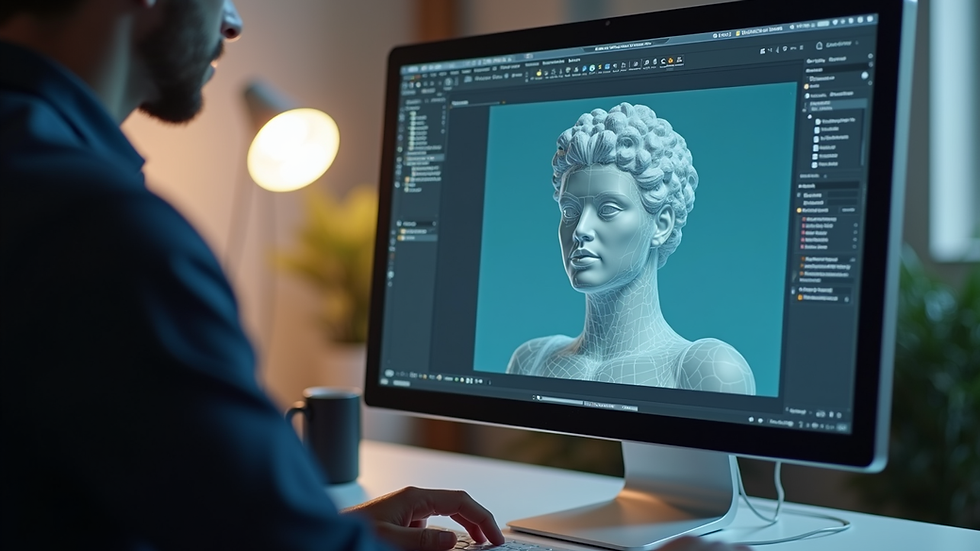
This close-up shows how AI tools assist in refining 3D models, speeding up the design process.
Comparing Key Products for 3D Visualization
When choosing tools for 3D visualization, it helps to understand what each product offers and how they fit different needs.
3D Studio Max
Best for detailed modeling and animation. It offers deep control over every aspect of the design but requires a steeper learning curve. Ideal for professionals who want to create polished, high-quality visuals.
Unreal Engine
Excels in real-time rendering and VR experiences. It’s perfect for interactive presentations and immersive walkthroughs. It’s also free to start, which makes it accessible for many users.
NVIDIA Omniverse
Focuses on collaboration and AI-enhanced workflows. It’s suited for teams working on large projects who need to share updates instantly and automate parts of the process.
Each of these tools brings something unique to the table. Depending on your project’s scale and goals, you might use one or combine several to get the best results.
The Future of 3D Visualization
Looking ahead, I see 3D visualization becoming even more integrated with other technologies. Imagine combining augmented reality (AR) with 3D models to overlay designs directly onto real-world sites. Or using AI to generate entire design options based on a few input parameters.
The role of 3d visionaries is crucial here. These experts push the limits of what’s possible and help others adopt new tools effectively. Their work makes it easier to bring architectural, interior, and product visions to life with clarity and detail.
For anyone involved in design or development, staying updated on these innovations is key. The right 3D visualization can turn abstract ideas into tangible experiences, making projects smoother and more successful.

This image captures the immersive experience of exploring architectural designs through virtual reality.
The advances in 3D visualization are opening doors to new creative possibilities. Whether you’re designing a building, an interior, or a product, these tools help you see the future before it’s built. By embracing innovations like real-time rendering, VR, and AI, you can deliver clearer, more engaging presentations that inspire confidence and excitement.
If you want to explore these technologies further, consider how products like 3D Studio Max, Unreal Engine, and NVIDIA Omniverse fit your workflow. They represent some of the best options available today.
For those looking to partner with experts who understand these tools inside and out, 3d visionaries offers a path to stunning 3D visualizations that bring your ideas to life with exceptional clarity and detail.
Explore the future of design with 3D visualization and see your visions come alive.


Comments